Part 3 – Application
What Is Joy?
Joy = Relationship.
Joy = Someone is glad to be with me.
If someone is glad to be with me, even when I am experiencing the Big Six upset emotions (e.g., fear, anger, sadness, shame, disgust and hopeless despair), and they have the maturity and capacity to keep their relationship with me bigger than the problem I am experiencing, I will learn how to recover from upset, return to joy, and endure hardships well in the future.
The Joy Center in the Brain
The “joy center” in the brain (also known as “the Banana” or Level 3 of the Right Control Center) develops between 6 weeks and 10 months of age. It is the area of the brain that helps us learn how to return to joy from the Big Six upset emotions.
When this stage of development is interrupted or does not occur during early childhood, a person grows up with holes in their maturity into which they fall when hardships in life arise. They fail to thrive because their return to joy skills are weak or nonexistent.
One of the objectives of practicing “Return to Joy” exercises in adulthood is to “rewire” the fast track white matter in the front of the brain so that “the Banana” in the center grows bigger and stronger than the emotionally upset feelings it must regulate in the back.
Practice Exercises
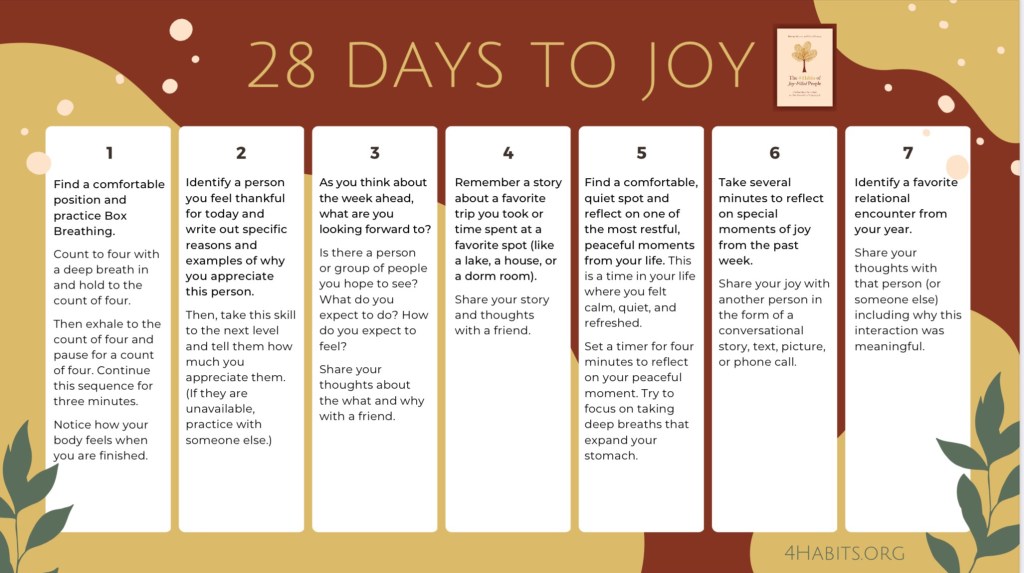
The practice exercises shared here are from the book, The 4 Habits of Joy-Filled People (C. Coursey, 2023). More free tools and resources are available at https://4habits.org.
I am particularly fond of this resource because I sponsored a “HR Happy Hour” event in the teacher’s lounge at school! (Non-alcoholic, prebiotic beverages were served in case you were wondering.) 😊
I mention this because at one of the snack stations I placed a glass bowl and labeled it, “Tip Jar”. The catch was they were not supposed to put a tip into it, but take a joy tip from it that I cut out from this resource.
They absolutely loved it!
Conclusion
Long story short, in answer to Francisco’s question (if that is even honest to say after having you go through a three-part, mini-masterclass!), a practical way I practice joy skills is by training the right control center of my brain how to return to joy through sharing gratitude-based thoughts and feelings with my family and friends on a regular basis.
-Robert

