
“The Quiet Time Principle”
“The secret of my success is simple. It is found in the Bible.”
— George Washington Carver
Hi! My name is Robert West. I’m “The Quiet Time Planner Guy”.
I’m the guy who helps busy, goal-oriented people schedule daily quiet time to meet with God so they can experience the joy and rest of His presence in their daily lives.
I achieve this objective with the help of a calendar system I designed called (you guessed it), “The Quiet Time Planner™”.
The Quiet Time Planner™ is not your typical datebook/organizer. It is an award-winning “right brain” calendar system that is custom-designed to help busy, goal-oriented people schedule daily quiet time to meet with God so they can experience the joy and rest of His presence in their daily lives.
The system was inspired by the response I received from a whispered prayer I offered to God for healing from a serious case of chronic fatigue immune dysfunction syndrome (CFIDS) with which I was suffering.
During my recovery, the Lord began showing me an effective and sensible way to manage my life. It centered on spending consistent uninterrupted, daily quiet time with Him.
Along the way, I was introduced to other general principles and concepts of effective time management that were helpful to me.
In this post I will focus on “The Quiet Time Principle” and discuss how this concept makes The Quiet Time Planner™ unique among calendar systems.
The Eisenhower Matrix
“I have two kinds of problems: the urgent and the important. The urgent are not important, and the important are never urgent.”
— Dwight D. Eisenhower
As I made progress in my recovery from CFIDS, my doctor gave me notes to give to my employer stating I was cleared to go back to work a limited number of hours each week. I started out with 15 hours per week, then 20, then 25.
In those early days when I was released to return to work, I was determined to not aggravate the stress condition again and have a relapse. So, I began to conduct personal research into the subject of effective time and life management to learn what the subject matter experts had to say.
As I read success books and listened to motivational teachings on my cassette tape player (remember those?), I discovered that most of what people had to say about time management was in some way or another based on the “four quadrants” idea formulated by General Dwight D. Eisenhower and later popularized by Stephen R. Covey in The 7 Habits of Highly Effective People.
This idea is best illustrated by the picture below.
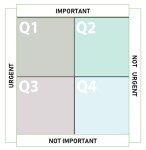
For me, however, the “problem” I faced was a relational one more than a tactical one. My major concern was how could I maintain the “quiet time” lifestyle I had enjoyed while away from work, and still perform the duties of my job effectively working fewer hours.
Thankfully, the Lord addressed this relational concern when He gave me the idea to develop The Quiet Time Planner™ calendar system. The answer was contained in a concept I call, “The Quiet Time Principle”.
The Quiet Time Principle
The essence of the “Quiet Time Principle” involves organizing your schedule around quiet time as a central priority, instead of trying to fit quiet time into a schedule of activities.
The principle is based on the Bible verse,
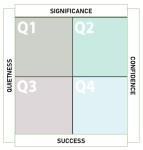
“…In quietness and confidence shall be your strength.…”
— Isaiah 30:15 (Emphasis added)
As a tennis player, I knew how important it was to keep the ball from going out of bounds during a match. So, quietness and confidence were the “sidelines” I needed to keep in mind to prevent my life from going out of bounds sideways.
The “baseline” boundaries that would define what was “important” verses “not important” (and from which I gained clarity, power and conviction to say “No!” to the tyranny of the urgent), were derived from ideas that are consistent with this quote:
“A person of character seeks true happiness in living a life of purpose and meaning, placing a higher value on significance than success.”
— Michael Josephson
Taken together, The Quiet Time Principle is best illustrated by the picture below.
Pickleball, Tennis, and The Quiet Time Planner™
Pickleball is the fastest-growing sport in America. From a newcomer’s perspective, pickleball and tennis may seem identical, but there are major differences between the two sports. The side-by-side comparison of the court designs below provide a starting point for beginning to understand why pickleball is unique in the racquet and paddle sports world.
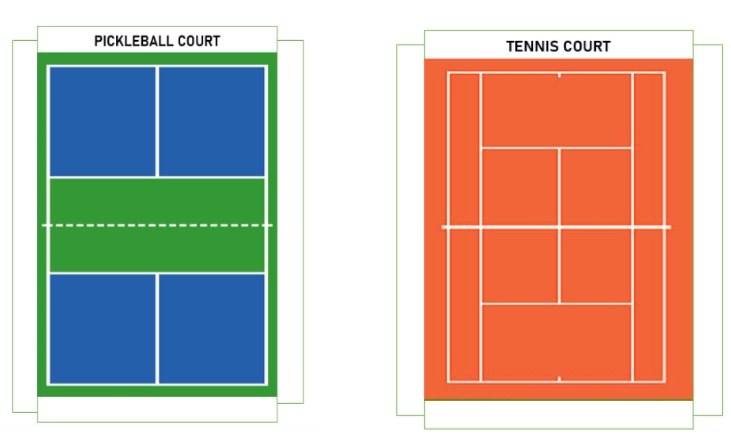
The same may be said of the difference between traditional Eisenhower Matrix-based calendar systems and the transformational Quiet Time Principle-based system.
From a newcomer’s perspective, traditional time management systems may seem identical to The Quiet Time Planner™, but there are major differences between them. The side-by-side comparison of the four quadrant designs below will help you understand why The Quiet Time Planner™ is unique in the calendar world.
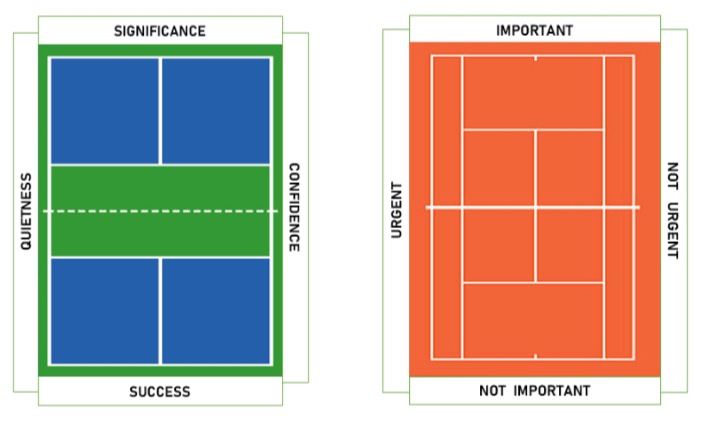
In future posts, I will fill-in the types of work and priorities that best fit into each of the four time management quadrants. I will also demonstrate how to use traditional time management and “quiet time” management principles, concepts, and perspectives in ways that I believe will transform the way you view your schedule and use your calendar.
See you next time!
Robert West, The Quiet Time Planner Guy


Thank you for this Robert! It’s so great!xocarol huston
LikeLiked by 1 person
Thank you for this Robert! It’s so great!xocarol huston
LikeLiked by 1 person